VMware Cloud Foundation 9.1

With the introduction of VMware Cloud Foundation 9.1, Broadcom demonstrates its strong commitment to the continued development of modern private cloud platforms. The latest version is now generally available and introduces a range of innovations that give organizations greater control over automation, security, and the operation of both traditional and cloud-native workloads. In this article, we share our perspective on VCF 9.1 from the viewpoint of a Cloud Service Provider.

Written by
Larik-Jan Verschuren
&
Arnoud Kamphuis
Posted on
11
-
05
-
2026
2024
Written by
Larik-Jan Verschuren
&
Arnoud Kamphuis
Posted on
11
-
05
-
2026
2024

VMware Cloud Foundation brings together many operational business components within a single ecosystem. At its foundation is the efficient use of hardware resources for compute, storage, and networking. In addition, VCF provides a unified platform where both modern and traditional workloads can run side by side. Security is also deeply integrated into the stack. Because all traffic remains within the VCF environment and is processed directly by the hypervisor, organizations gain detailed insight into traffic flows while also being able to protect traffic through granular firewall policies. Combined with NSX and vDefend, this creates a powerful framework for securing applications across the entire platform.

From VCD to VCFA

Today, Fundaments delivers its Private Cloud services through VMware Cloud Director. With VMware Cloud Foundation, a new future-ready portal is introduced: VCF Automation.

This portal introduces a wide range of new capabilities, from deeper insights into consumption, compliance, and security to the automated deployment of workloads through infrastructure and application-as-code, including CI/CD pipelines. This enables organizations to consume and manage Private Cloud resources in a far more automated and scalable way.

For our Private Cloud customers, this means that alongside traditional virtual machines, cloud-native applications can also be supported through Kubernetes, based on vSphere Kubernetes Service. In addition, the platform is ready for AI-native workloads thanks to the Supervisor concept.

The image is a dashboard layout displaying a project management system with sections for overview, policies, users, services, and various statistics.AI-generated content may be incorrect.

The Supervisor enables the underlying vSphere resources to be utilized across a wide range of services and functionalities. This includes Kubernetes clusters, virtual machines, storage volumes, and advanced load balancing capabilities.

At the moment, we are exploring the most effective way to support our customers in migrating from VMware Cloud Director to VCF Automation as smoothly and efficiently as possible.

Memory Tiering and vSAN Storage Efficiency

For Fundaments, the new release introduces capabilities that allow us to further improve hardware efficiency within our datacenters.

Memory Tiering

The diagram illustrates a comparison between different types of memory, specifically logical memory, DRAM, and NVMe.AI-generated content may be incorrect.

In times of scarcity, particularly when it comes to DDR memory, it is essential to utilize compute resources as efficiently as possible. Broadcom has introduced the concept of Memory Tiering to address this challenge. With this approach, inactive memory from servers and applications is offloaded to a local NVMe disk, making more active memory available to the hypervisor. This enables higher density per host and helps mitigate the rising costs of physical server infrastructure.

vSAN ESA

The image displays a dashboard for monitoring the capacity and efficiency of a storage system, showing total usable capacity, used capacity, and various metrics related to data management.AI-generated content may be incorrect.

With the introduction of VCF 9, a new version of vSAN was also released: ESA (Express Storage Architecture). With the announcement of VCF 9.1, the efficiency of vSAN storage has increased even further. The compression and deduplication capabilities of vSAN have been further enhanced, and in our own lab scenarios we are seeing data reduction ratios approaching 2:1, whereas this was traditionally closer to 1.3:1.

Version 9.1 also introduces AutoRaid for vSAN, a way to automatically place workloads on the appropriate storage profiles, ensuring that storage aligns as closely as possible with the required performance and redundancy levels. Broadcom has also published research showing that the use of vSAN ESA can reduce costs by up to 39% compared to traditional storage arrays.

Private AI ready

VMware Cloud Foundation 9.1 has further evolved in its capabilities for hosting AI workloads. Support for GPUs has been expanded, particularly across the AMD portfolio, and live migration of GPU-enabled workloads is now possible. This marks the next step in the virtualization of GPU resources.

In addition, support for multiple data sources via the Model Context Protocol has been significantly extended. The announcement demonstrated how easily Google Docs can be connected to an AI model for integration and processing.

These developments make it increasingly straightforward to offer an AI factory based on VCF for our customers, reducing the level of expertise required to connect and integrate data from multiple sources.

SQL Database as a Service

With VCF 9.1, it is also possible to deploy databases as a service through the VCF Automation platform. This includes support for both SQL and PostgreSQL. Through self-service, a database can be deployed, automatically scaled, backed up, and fully managed via automation.

The image displays a screenshot of a Database Service Manager interface, offering tools for managing PostgreSQL, MySQL, and SQL Server databases in VMware environments.AI-generated content may be incorrect.

Simplifying the management of complex networks

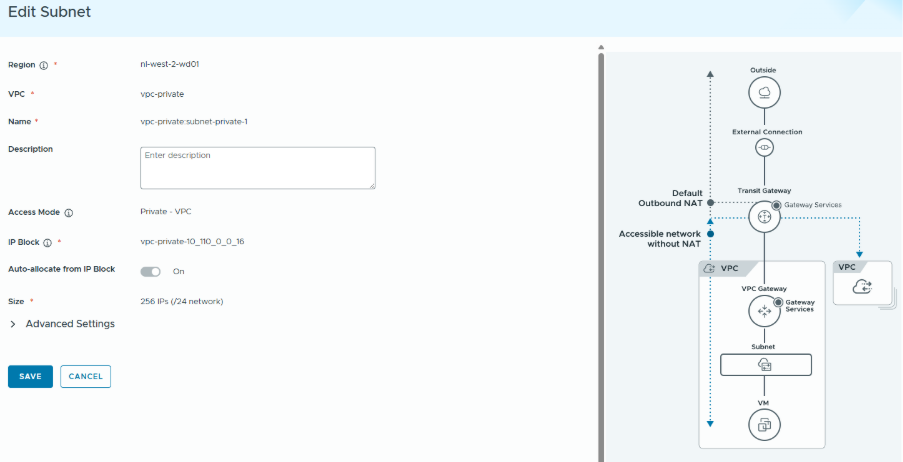
With VMware Cloud Foundation 9.1, the integration of networking components with NSX has been further expanded. Complex network architectures can now be easily requested and even fully automated in their deployment. All deployment steps are handled by the platform, presenting users with the so-called “desired state” of the environment. These types of concepts are essential for operating a software-defined data center.

The image displays a user interface for setting up a subnet configuration in a Virtual Private Cloud (VPC), including options for IP block, network size, gateway services, and advanced settings.AI-generated content may be incorrect.

We see that Broadcom is delivering on its promised pace of innovation and executing its roadmap as planned. The vision of delivering a complete, modern private cloud comes together in VCF 9.1.

Would you like to learn more or receive a demo of VCF 9.1? Feel free to contact Arnoud.

No items found.