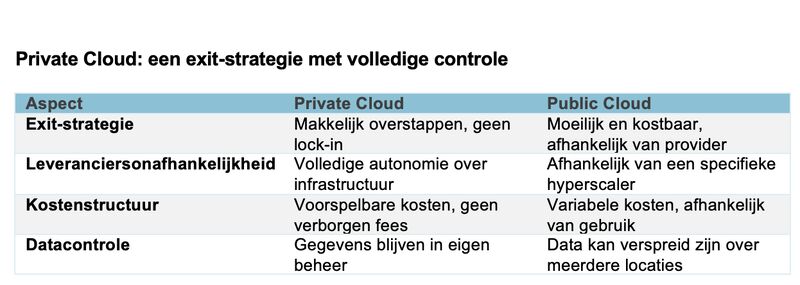
Many organizations realize too late that switching to the Public Cloud often comes with vendor lock-in. Public cloud providers like AWS, Azure, and Google Cloud design their platforms in such a way that migrating to another provider becomes technically and financially challenging.
Exit strategy & vendor independence: why Private Cloud is the key
Many organizations enthusiastically switch to the Public Cloud, only to realize too late that they have surrendered their freedom. Major cloud providers like AWS, Azure, and Google Cloud make migrating to another environment technically and financially complex. The consequences? Limited freedom of choice, unpredictable costs, and a strong dependency on a single vendor. In this article, you will discover why a Private Cloud strategy offers a powerful alternative – with maximum control over your IT, predictable costs, and the freedom to decide who you work with.


Written by
Posted on
20
-
08
-
2025
2024
Written by
Posted on
20
-
08
-
2025
2024
The risks of hyperscaler lock-in
Limited exit options: switching from one Public Cloud to another can be complex and costly.
Proprietary technology: many hyperscalers use their own technologies that are not compatible with other systems.
Unpredictable costs: data traffic and storage costs can increase significantly over time.
Private Cloud offers a solid alternative here: a flexible IT infrastructure without dependency on a single vendor.
The long-term benefits
✅ Freedom to choose vendors and technologies
✅ Data control remains within the organization
✅ Predictable cost structure without unexpected expenses
✅ Easy integration with industry initiatives such as Common Ground for municipalities
Private Cloud offers the best solution for organizations that want a flexible and future-proof IT infrastructure without the risks of vendor lock-in.
Curious about what a Private Cloud strategy could look like for your organization?
