2024 is almost over. In addition to the music and news lists that traditionally pop up in December, it's good to look up to the changes in 2024 with Cloud glasses. What did we see? Cloud is still seen as convenience, but there is growing awareness among users about data ownership and associated data classification. Simply put, we are increasingly looking at which data should end up in which Cloud.
2025: change in top speed
In this article, Larik-Jan Verschuren, CTO at Fundaments, looks back on 2024. What changes did he see and what is the role of sovereign Cloud in this? He also looks ahead to 2025 and explains, among other things, what he expects in the field of AI.


Written by
Posted on
16
-
12
-
2025
2024
Written by
Posted on
16
-
12
-
2025
2024
Different types of Cloud
Thanks to the growing awareness, users are also increasingly looking at the different types of Cloud: Public, Hyperscaler, Private and Self-Hosted Cloud are the most mentioned. And all of these Clouds have their own characteristics. The Hyperscaler Cloud excels in convenience and extensive possibilities, but this naturally also makes the cost model more challenging.
Private Cloud has gained ground in this regard. Not because of the multitude of options, but precisely because of the local character and the personal approach of the Private Cloud parties. The Self-hosted Cloud has also gained ground for larger companies, mainly due to remigration from the Public Cloud. Invariably from a cost point of view.
With the changing world with wars on multiple continents and new rulers in different countries, the demand for self-reliance has increased. This also applies to Cloud. Storing data in the Cloud has made more and more organizations and companies realize that there is a dependence on the Cloud in business operations, but also that access to data is a risk.
Sovereign Cloud
In order to ensure that data is not only available and accessible, but also protected against access by foreign powers, in addition to technology, we also look at the legal aspects of storing data. Who has access to the data and where is the data stored?
The sovereign Cloud has the definition that technology, jurisdiction and business operations ensure that data is stored in accordance with the laws of the country where this Cloud is hosted. The term sovereign Cloud originated a few years ago from the premise that this Cloud is organized from a number of aspects. These aspects are shown in the figure below. Think of data locality and classification, but also local management by a sovereign entity, where continuous compliance with laws and policies is key. In addition, innovation and modernization are being achieved within the sovereign domain. A good example is Private AI, which also includes all AI and DATA Act applications.
You can read more about this in our blog article about the sovereign Cloud of Fundaments.
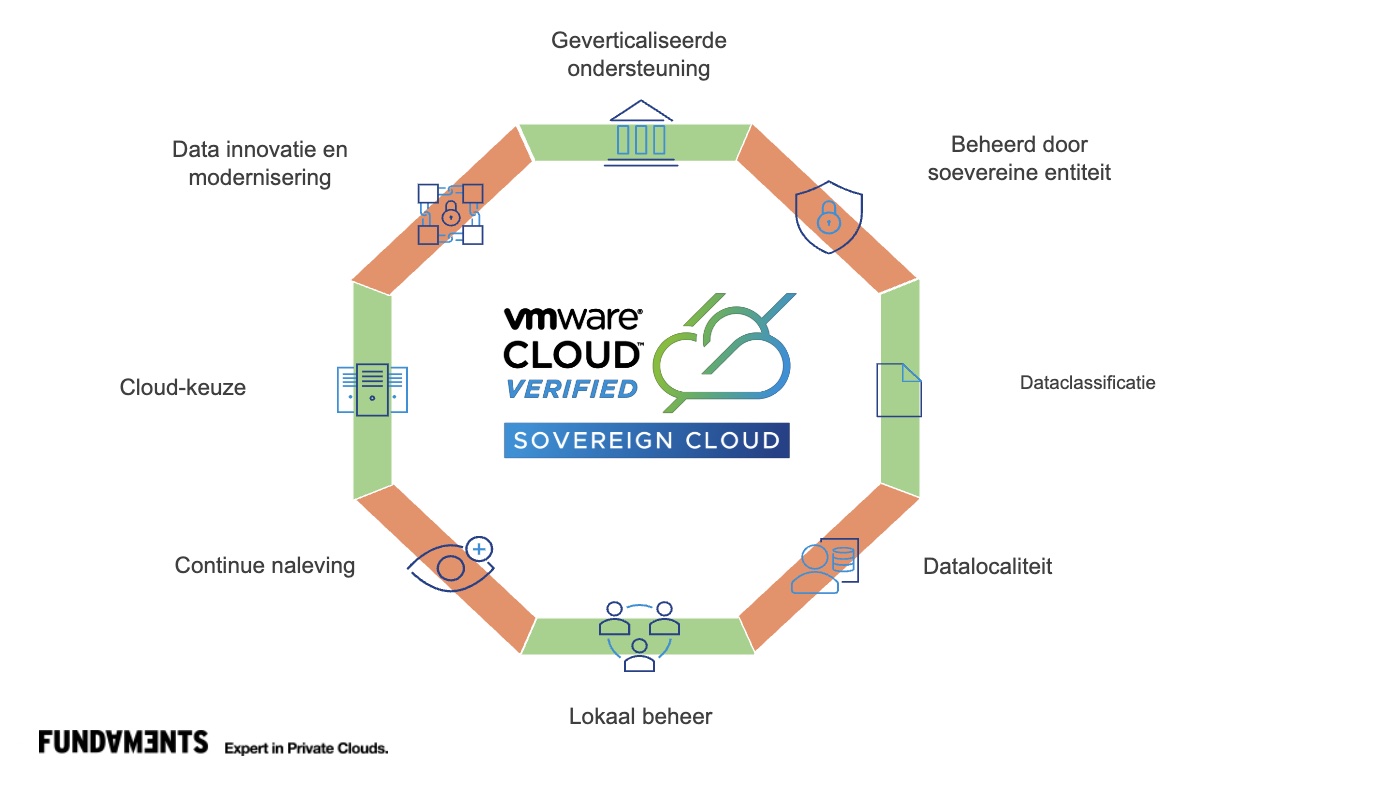
This term has already been positioned as a definitive variant of Cloud. Cloud sovereignty is within the European Union already a topic, but now also within Dutch politics. For example, the Secretary of State for Digitization, Zsolt Szabó, recently spoke about the sovereign Cloud or as he also called it: autonomous Cloud. Here, the definition is not entirely clear yet. But this shows the signal and the call for more autonomy when we talk about Cloud solutions.
Amendment to the directive in Cloud tenders
The wish for more autonomy is also driven by procurement guidelines for Cloud. This initiative demands that government data be protected against interference by a foreign power. This will require full insight into where and how data is stored, as well as who has access to the data. The company that operates the Cloud is therefore subject to laws and regulations from the country in which it operates. This also applies to employees. All parts of the overall 'governance' of the data stored in the Cloud.
When we look at the public hyperscalers in America from this discussion, we see different answers. Building a sovereign Cloud on European territory by, for example, Amazon and Microsoft Azure it highlights the necessary measures. But here the question is whether the overall package is correct. Bert Hubert explains this very nicely in this article
So do it yourself?
The time has come to take matters into your own hands in the Netherlands and Europe. Due to geopolitical issues, we need to stand more on our own feet and become self-sufficient on many fronts, such as energy supply and defense. This applies equally to digitization and thus Cloud infrastructure. Is this possible? Sure.
In the Netherlands, we have great knowledge parties and there is plenty of expertise in the field of private and sovereign Cloud. This knowledge must be requested by the policy maker and included as a mandatory part of the Dutch and European Cloud infrastructure. Then a nice platform will be able to be created.
What about AI?
2025 will be full of initiatives in AI applications. Organizations will actually convert initiatives into products and services. This also focuses on data and it will be necessary to thoroughly look at how this is protected. In fact, there will also be more problems if it is not properly looked at how the data used by AI is protected. I also expect a few spectacular cases in 2025.
When training models, it is necessary to take a close look at which data and roles apply to the use of data. So here, too, it's not just about technology, but also about regulation. The Data Act and AI Act also aim for this in Europe. This policy will ensure that the data used by AI will be used wisely. Many voices say that this legislation is hampering development and is hampering innovation; on the contrary, I think it sets the barriers in the event of data disasters.
Fundaments and 2025
There are great plans in the pipeline for 2025 that I will further explain in the new year. The common thread will always be the continuity and protection of your company's critical data, whether it concerns applications, platforms or AI. With the Private Cloud solutions, we can offer solid building blocks that ensure safe access and protection in storage. And with our fantastic team, we provide an accessible partnership in the development and support of your Private Cloud.
So enjoy the holidays and let's make 2025 a year of data control! I'm looking forward to it.

Related blog items
No items found.
